

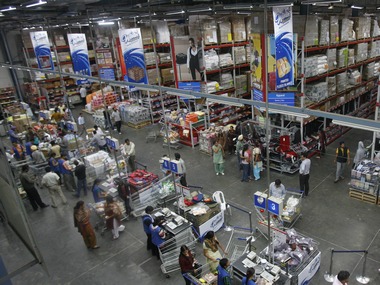
 "No logic in allowing FDI for Flipkart and Snapdeal and excluding Wal-Mart")
By Shanti Priya Arnal A few weeks ago, the Department of Industrial Policy and Promotion (DIPP) apparently came out in support of marketplace e-commerce firms Flipkart and Snapdeal when it said they should be regulated like brick-and-mortar retail firms. This was in response to the Commerce Ministry’s earlier call to bring e-commerce under the purview of nine government agencies including DIPP. DIPP has argued that too much regulation would “curtail innovation and the spirit of entrepreneurship” and kill e-commerce in India. Even as one agrees with DIPP that marketplaces should be treated like brick-and-mortar retailers, one wonders why DIPP thinks that e-marketplace companies are eligible for foreign direct investment (FDI), when the present administration is clearly against allowing FDI in brick-and-mortar multi-brand retail.[caption id=“attachment_821725” align=“alignleft” width=“380”]  Not smart by excluding Wal-Mart. Reuters[/caption] For all practical purposes, Flipkart and Snapdeal act and appear like multi-brand retail stores. For instance, on Flipkart, a buyer can choose from a range of different brands of a product and there are multiple products displayed - much like what is available in a brick-and-mortar mall like Big Bazaar or Reliance Mart. Similarly, at the time of payment, an online shopper settles a single bill at the marketplace payment gateway, even if his cart includes products sold by several different vendors. Besides, for any post purchase issue that the buyer may have with the any of the products, there is a single point contact with the marketplace for grievance resolution. In effect, the shopping experience that one gets is that of one large, seamless retail mall which happens to be online. In terms of operational functionality too, the distinction between the marketplace and the seller of goods on the marketplace is quite blurred. It is a well-known fact that eBay, Flipkart and Snapdeal - the marketplaces that supposedly only enable the meeting of sellers and buyers – actually decide the prices of the products sold on their site and get to determine the discounts to attract customers. Often the product price tag they set is way below the price at which the vendor is willing to sell. In fact the same vendor in his offline avatar refuses to part with a product at its online price saying that that the lower offer prices are valid only if the orders come through the online marketplace. It is, therefore, evident that the marketplace company reimburses the vendor the value of the difference between his selling price and the price at which it is actually sold the products online. It is well known that marketplace companies are able to fund these discounts only because they have FDI money backing them to build the e-commerce business model. Since, e-marketplaces have complete discretion to decide on what products and which vendors would be eligible for discounts, they can be selective about the retailer they choose to nurture with FDI money. It is very likely that some preferred retailers will enjoy the lion’s share of marketplace-funded discounts, thus gaining effective, though indirect, access to the otherwise forbidden FDI money. This process, if carried on long enough, will allow the preferred retailers an unfair advantage to grow and outdo other retailers who are not quite as preferred. Marketplace firms may even have indirect holdings in such retail firms that they choose to nurture with reverse discounts and, when policy permits, they may take them over. This flow of money in the reverse direction - from the downstream marketplace to the upstream seller - is not sustainable in the long run. Yet it can be a category killer in the short run. It has the potential to render many small retailers’ physical stores unsustainable as more buyers go online for unmatched discounts. Initially, small retailers in cities will have little to complain as sales are happening anyhow once they are online. They might even be lulled into complacency and a false belief that it is more profitable to have only an online presence, and even give up their brick-and-mortar presence. As more and more customers come online, lured by FDI-funded discounts, more new online marketplaces will emerge with an expanded product range that will include groceries and perishables. Once the online marketplaces are well established and have a reputation, they will look at becoming profitable and giving returns to their foreign investors. Like any other business they will look at efficiencies. The e-commerce supply chain will then be reorganised to cut the flab and the small retailer who had moved online will be its first casualty. Manufacturers or wholesalers or large retailers will then emerge as direct sellers on the marketplace. E-commerce marketplaces will thus be instrumental in bringing about the demise of the small retailer. And ironically, policymakers have been holding back FDI in multi-brand retail over the last decade precisely to protect small retail. The government has feared that big box foreign retailers like Wal-mart and Tesco, with their deep pockets, will adopt predatory pricing strategies and mark down retail prices for a sustained period of time with a view to driving the small retailer out of business. Interestingly, e-commerce marketplaces can do just that with far wider ramifications on small retailers across the country than a foreign owned brick-and- mortar retail mall. The power of a Wal-mart store to adversely impact the small retailer is limited to those located in and around it, while, with very little physical investment, an online marketplace can ring the deathknell of kirana shops located in remote towns anywhere in the country. Since the e-commerce marketplace has the power to determine the prices of products on its marketplace, it should indeed be regulated like a multi-brand retailer like Big Bazaar or Reliance, notwithstanding its apparent structural differences. Keeping in mind the concerns of the small retailer, which has been the spirit behind the policy on FDI in multi-brand retail, the government should review FDI in marketplace e-commerce companies too, as they can prove to be as disruptive as the big box foreign multi-brand retail companies. If after due consideration, the government comes to the conclusion that FDI in e-commerce is necessary for ‘innovation and entrepreneurship’ then it would be grossly unfair to keep FDI away from the brick-and-mortar multi-brand retail. Surely it cannot be the purpose of policy to protect FDI-funded e-commerce marketplaces in their nascent years when they pose as much danger to small retail as the big box foreign retailers? If we must allow the e-commerce marketplaces in the name of innovation, then they must at least be exposed to competition. Let their success not come from over-regulation of the brick-and-mortar retail industry. Indeed, one should regulate e-commerce marketplaces like brick-and-mortar retail firms. Else, e-commerce marketplaces will provide backdoor entry for FDI in the Indian multi-brand retail sector. The author is an economist.
The market disruption caused by e-marketplaces like Amazon, Flipkart and Snapdeal will be the same as what a Wal-mart could cause in multi-brand in retail. If we need FDI in e-marketplaces, why not in brick-and-mortar big retail?
Advertisement
End of Article
Written by FP Archives
see more

 "Israel targets top Hamas leaders in Doha; Qatar, Iran condemn strike as violation of sovereignty")
 "Nepal: Oli to continue until new PM is sworn in, nation on edge as all branches of govt torched")
 "Who is CP Radhakrishnan, India's next vice-president?")
 "Israel informed US ahead of strikes on Hamas leaders in Doha, says White House")
 "Israel targets top Hamas leaders in Doha; Qatar, Iran condemn strike as violation of sovereignty")
 "Nepal: Oli to continue until new PM is sworn in, nation on edge as all branches of govt torched")
 "Who is CP Radhakrishnan, India's next vice-president?")
 "Israel informed US ahead of strikes on Hamas leaders in Doha, says White House")



](https://images.firstpost.com/wp-content/uploads/2013/05/consumers-reuters.jpg)