

 "Jobs puzzle: More Indians are dropping out of workforce")
Here’s a puzzle. Between 2004-05 and 2009-10, which broadly coincides with the UPA government’s first full term and one year of the second, India’s unemployment rate went down. But so has the labour force participation rate (LPFR), which is the number of workers available in the employment market - both those with jobs and those looking for one.
Are more people opting out of jobs? Or are the jobs available shrinking?
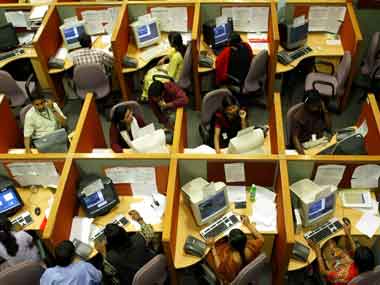
[caption id=“attachment_33985” align=“alignleft” width=“380” caption=“Is the Indian dream run in the right course? Sherwin Crasto/Reuters”] 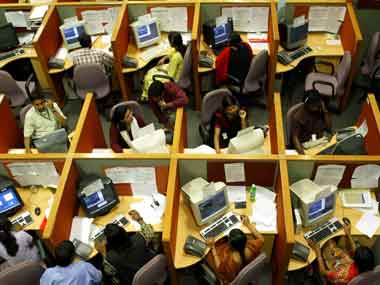 [/caption]
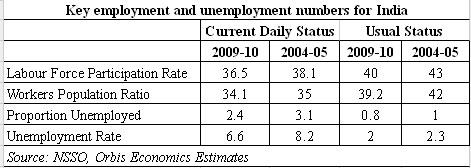
According to recently-released figures from the National Sample Survey Office (NSSO), the LPFR is down from 38.1% to 36.5% between 2004-05 and 2009-10, indicating that there are either fewer jobs available or fewer people seeking jobs. India’s demographic dividend is built on the premise of a growing working age population, but if we have so many copouts from the job market, the demographic advantage will go phut.
It seems that the path to development is not quite straight: rising educational attainment means a decline in workers in the younger age groups and women quitting work as family incomes rise in a growing economy.
In other words, in the short-term, socio-economic development tends to outweigh the impact of the ‘demographic dividend’.
The LFPR is measured in terms of “current daily status” and “usual status”. While the ‘usual status’, which is a more long-term annual figure, reflects a slightly better trend than the daily status, even here, there is a drop from 2004-05 (see table). The usual status combines the principal (or primary) source of employment along with subsidiary sources over the course of a year.
Impact Shorts
More ShortsIn other words, by any reckoning, the number of people who are willing to work in the economy has declined over the past five years.
If we look at the two components of the LFPR - the Worker Population Ratio (WPR), or the number of employed persons in the population, and the Persons Unemployed (PU), which is the proportion of unemployed people as a proportion of population - a decline is visible across both.
While the WPR has declined to 34% (from 35% in 2004-05) as per the current daily status in the latest NSSO round, the proportion unemployed is then down to 2.4% from 3.1%. Declines are also visible in the daily status.
The Puzzle
The fall in LFPR is a curious phenomenon in a country that is seeing a rising number of people in the working age group every year. While one explanation for the decline could be the economic recession (or rather slowdown) in 2009-10, short-term economic trends do not explain the drop. Reason: if the decline in employment was on account of slower economic activity, we would see a rise in PU and the LFPR (people working or seeking work) would remain the same.
But since the PU has actually declined, it would mean that there are in fact enough jobs to go around in the market. A look at some of the employment surveys indicates that India actually has a robust job marke t, even with some slowing down.
So why is the proportion of workers in the population declining?
The explanation
In a report, the Planning Commission notes that within the working age group, as development takes place, people choose education over employment for longer periods. Further, as elementary education becomes universal and the incidence of child labour declines, the 10-14 age group will be virtually non-existent in the labour force.
Another explanation advanced for explaining the declining LFPR is that as per capita incomes rise, some women drop out of the job market. A look at the numbers shows that there is a drop in the proportion of employed women, even though fewer of them were unemployed compared to men. In other words, this particular group could be dropping out of the labour force voluntarily. The LFPR for women fell from 29.4% to 23.3% during this period.
Higher wages under the National Rural Employment Guarantee Act (NREGA) could also have impacted the total employment results, but the link is still to be established.
Over time, the commission expects the LFPR to grow at the same pace as the working age population as demographic patterns stabilise. Till then, however, the impact of the demographic dividend might not show up in all its glory.


 "Israel targets top Hamas leaders in Doha; Qatar, Iran condemn strike as violation of sovereignty")
 "Nepal: Oli to continue until new PM is sworn in, nation on edge as all branches of govt torched")
 "Who is CP Radhakrishnan, India's next vice-president?")
 "Israel informed US ahead of strikes on Hamas leaders in Doha, says White House")
 "Israel targets top Hamas leaders in Doha; Qatar, Iran condemn strike as violation of sovereignty")
 "Nepal: Oli to continue until new PM is sworn in, nation on edge as all branches of govt torched")
 "Who is CP Radhakrishnan, India's next vice-president?")
 "Israel informed US ahead of strikes on Hamas leaders in Doha, says White House")



](https://images.firstpost.com/wp-content/uploads/2011/06/work380.jpg)
](https://images.firstpost.com/wp-content/uploads/2011/06/TABLEPIC.jpg)